The Windows at St. Paul’s
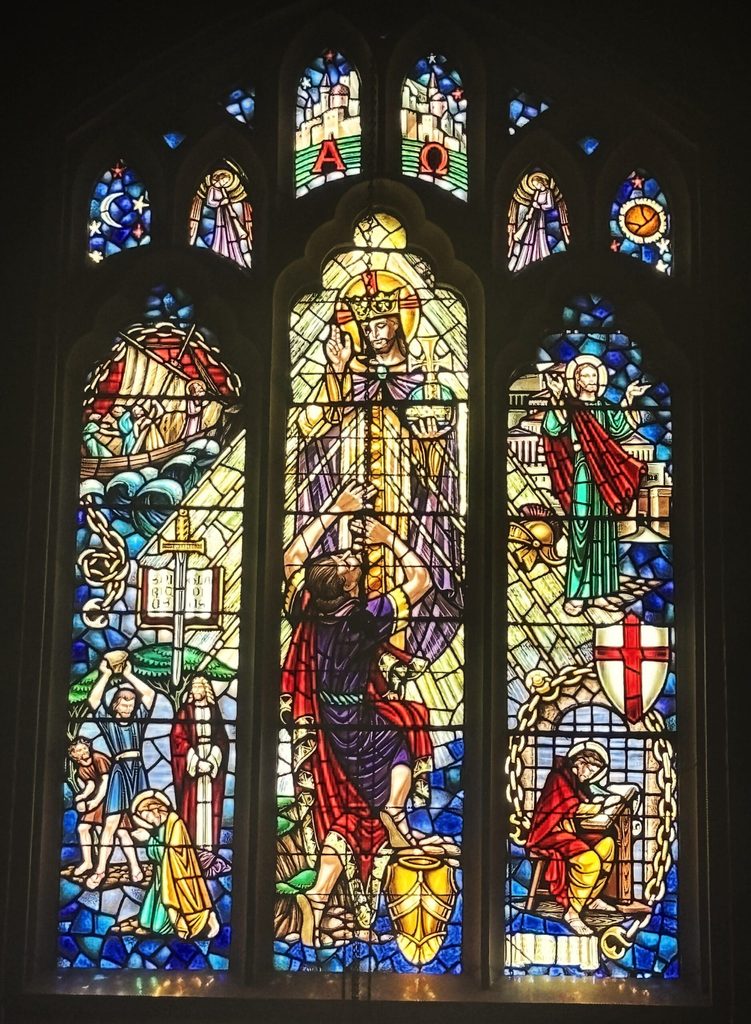
The great east window, over the high altar at the front of the church, depicts the life of St. Paul. The central image is of the conversion of St. Paul, as written in the Acts of the Apostles. Surrounding this image are depictions of the martyrdom of St. Stephen, at which Paul was present before his conversion, a ship surrounded by chains symbolizing Paul’s journey to Rome as a prisoner, Paul preaching the Gospel, and an image of Paul writing the Epistles, again surrounded by chains, signifying his captivity.
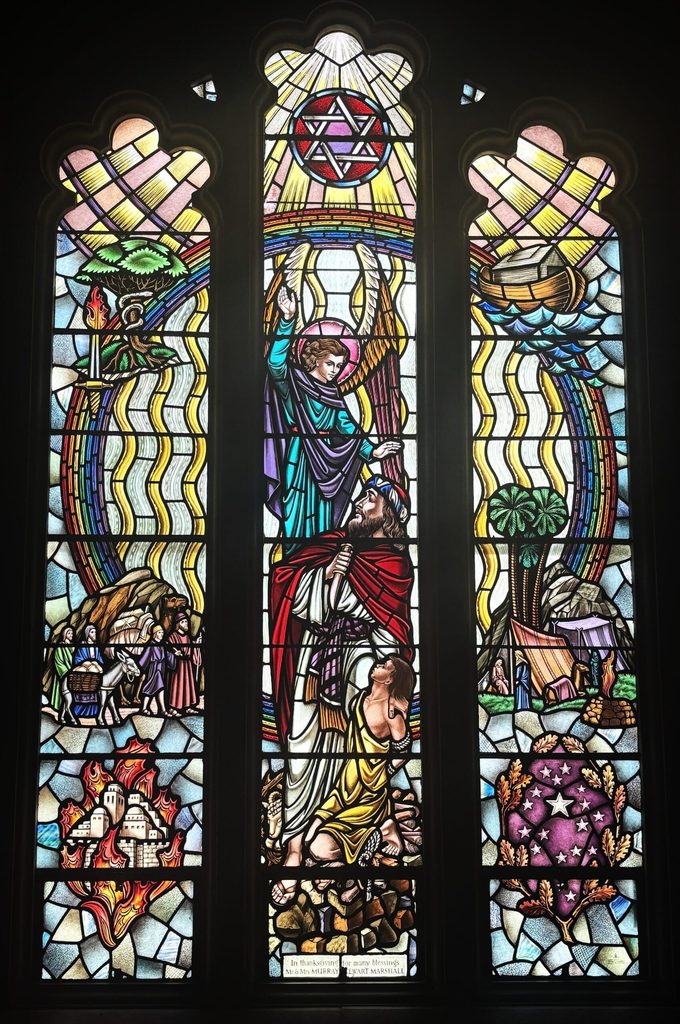
In the south transept, to the right as you face the high altar, are two windows, depicting Abraham and Moses. In the window on the left in the south transept Abraham is shown at the moment the angel intervened, just as he was about to sacrifice his only son Isaac, as told in chapter 22 of Genesis. The surrounding scenes symbolize the expulsion from the Garden of Eden, the wandering of the people of Israel in the wilderness, the destruction of Sodom and Gomorrah, Noah’s ark (which is also a symbol of the Church), and a symbol of God’s promise to Abraham to make his descendants “as numerous as the stars of the sky” (the stars are surrounded by the oak leaves of faithfulness). These images are all contained and unified in the symbol of the rainbow, God’s first covenant with his chosen people. Above all is the Star of David, symbolizing the both the Jewish faith and the six days of creation.
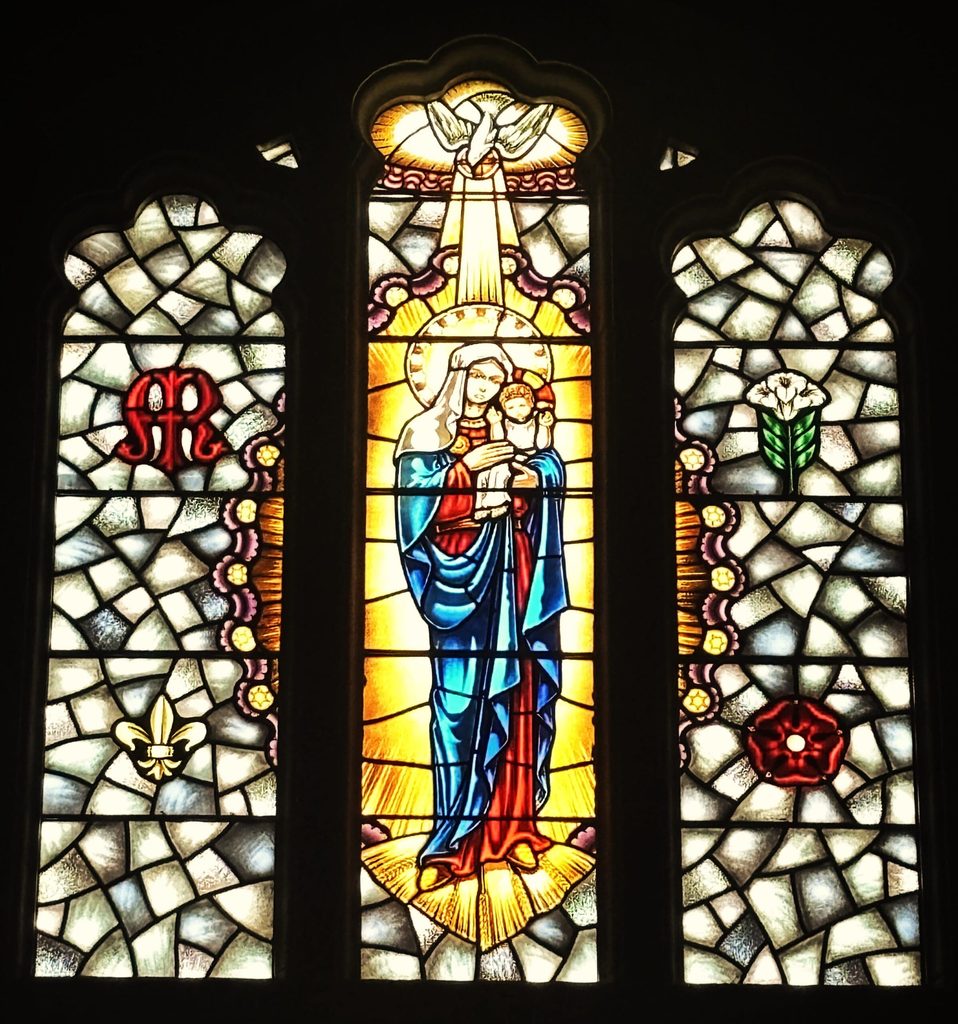
Over the Abraham window is a smaller window depicting Mary Queen of Saints, surrounded by her monogram, a lily symbolizing purity, the mystic rose, and the fleur de lis symbolizing the Trinity.
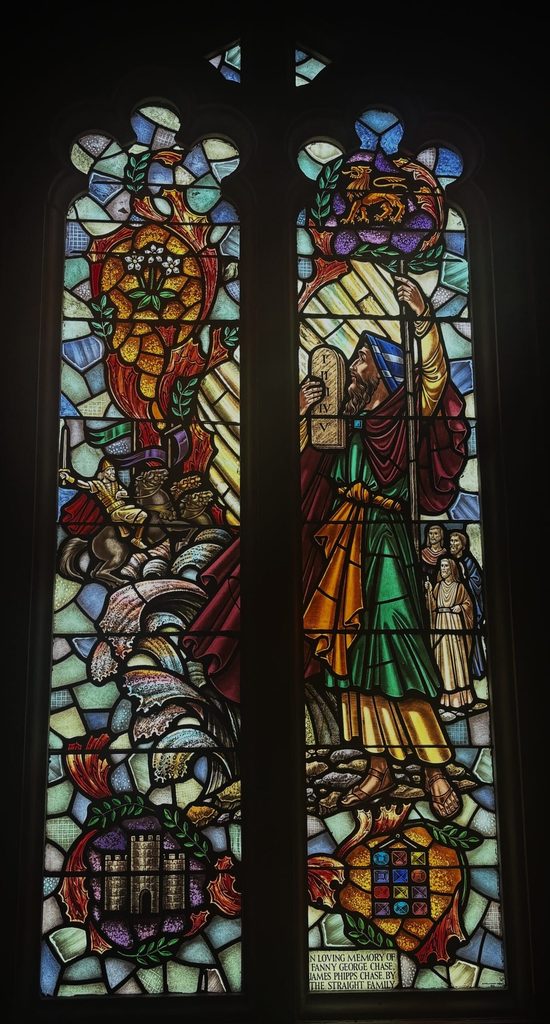
To the right of the Abraham window is the Moses window. Moses is shown holding the tablets of the law and leading the people of Israel through the divided Red Sea, being pursued by Pharaoh’s chariots, as told in Exodus, chapter 14. His calling at the burning bush is symbolized by the flames and leaves in the background. This window contains symbols of four of the twelve tribes of Israel, and symbols for the other tribes are found in neighboring windows. The flower symbolizes the Tribe of Reuben. The Tribe of Simeon is depicted as a city wall. The Tribe of Levi is shown as the breastplate of the High Priest, and the Tribe of Judah is seen as a lion.
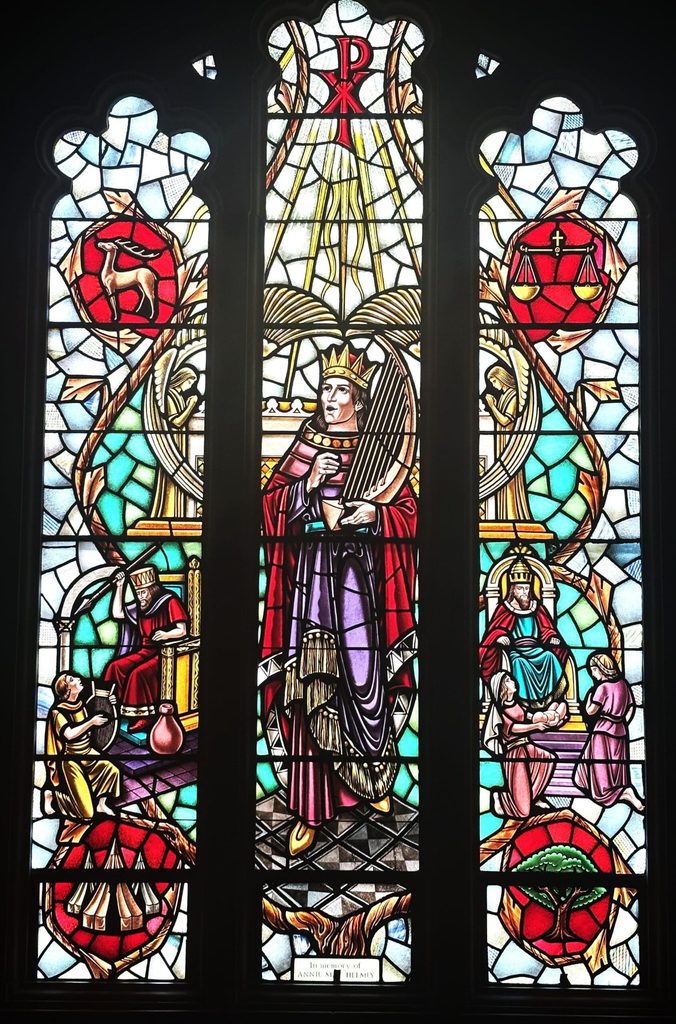
On the south side of the nave are three windows, depicting David, Isaiah and the Annunciation. In the central image of the first window David, the psalmist, is shown playing his harp in front of the Ark of the Covenant. In the smaller scene to the left the younger David is shown playing for King Saul, who threatens him with a sword. David succeeded Saul as King of Israel, and their story is found in the first book of Samuel. To the right the wisdom of Solomon, David’s successor as King of Israel, is shown, as found in the first book of Kings. These images are enclosed in and supported by a depiction of the tree of Jesse. At the top of the window is the one of the sacred monograms, the Chi Rho, signifying Christ, who was foretold by Isaiah and called “a shoot from the stump of Jesse” in chapter 11 of the book of Isaiah. Four tribes of Israel are also symbolized in this window: the Tribe of Naphtali is shown as a hart, the Tribe of Gad is symbolized by tents, the Tribe of Dan’s sign is the scales, and the tree signifies the Tribe of Asher.
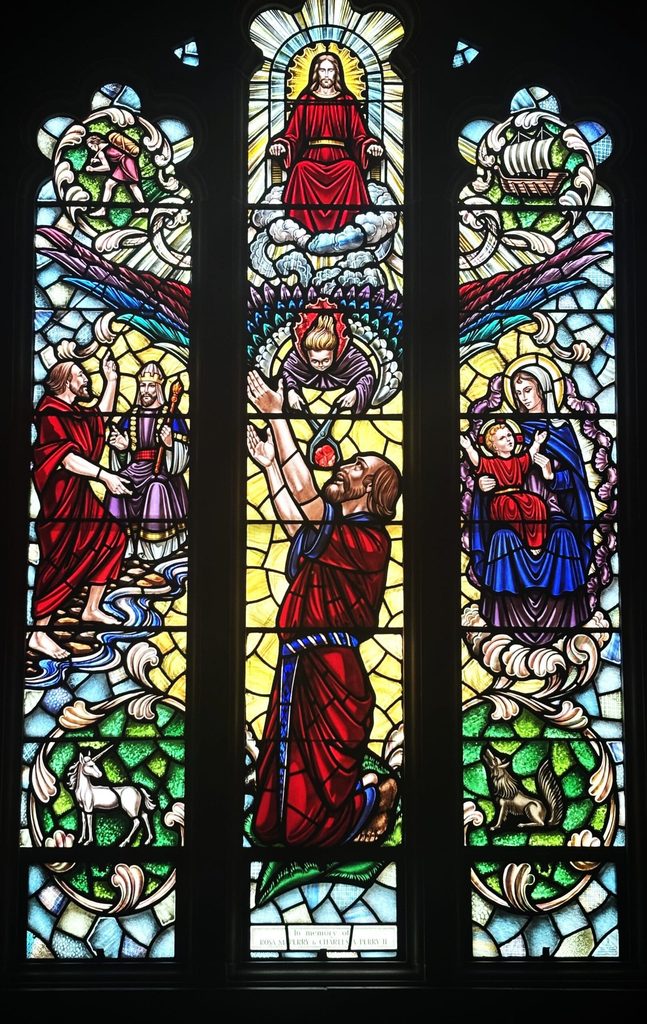
The main image in the next window is the vision of Isaiah where he saw the Lord seated upon a throne, surrounded by seraphim. One of the seraphim has come down from the Throne of God with a coal, which he touches to Isaiah’s lips to cleanse his iniquity and sin. This story is found in chapter 6 of the book of Isaiah. To the left is a depiction of Isaiah meeting King Ahaz to whom he prophesied the birth and reign of the Messiah, symbolized to the right. The remaining four tribes of Israel are shown in this, the last of the Old Testament windows: the Tribe of Issachar is the servant, the Tribe of Zebulun is symbolized in the ship, the Tribe of Joseph is shown as a unicorn (which is also a symbol of the Incarnation), and the Tribe of Benjamin appears as a wolf.
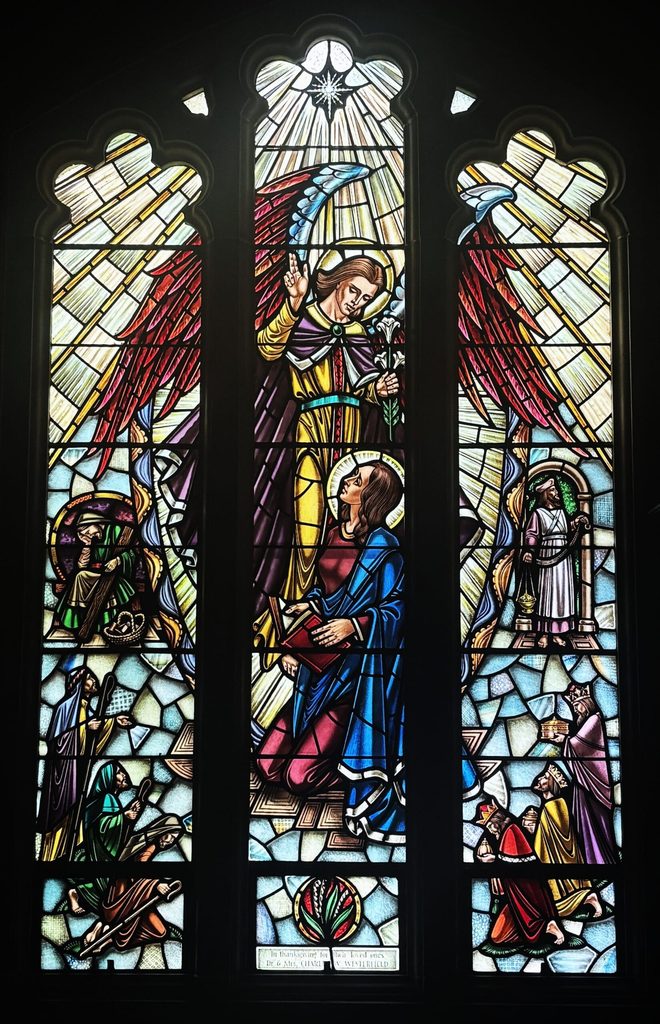
Imagery of the New Testament appears in the last window on the south wall of the nave. The Annunciation is shown, with the Angel appearing to the Virgin Mary to announce that she has been chosen by God to bear his Son. This lesson is found in the first chapter of Luke. The angel holds a lily, a symbol of purity, and Mary holds an open book, symbolic of the Law and her submission to God, “according to Thy word.” The smaller scenes all symbolize other experiences of the Angel of the Annunciation, who came to Joseph in a dream to tell him that Mary’s child was the Son of God, appeared to Zacharias to foretell the birth of John the Baptist, and who also came to the shepherds and kings to tell them of the birth of Jesus.
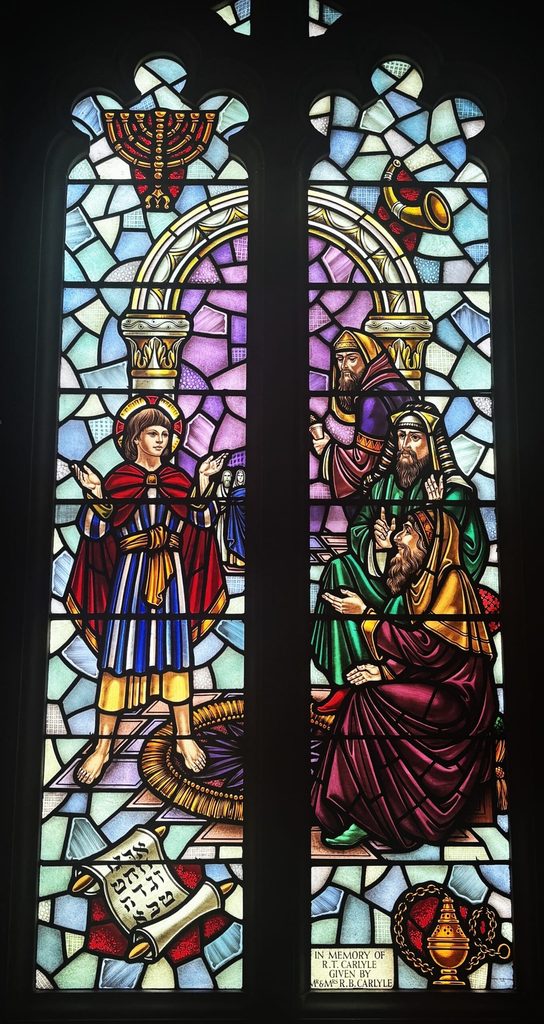
On the west wall at the back of the church are three windows. The window to the left depicts the young Jesus preaching in the Temple and astounding the elders of the Temple with his wisdom, as we read at the end of the second chapter of Luke. This is the first time that Jesus suggests he is the Son of God, because when his parents ask him where he has been he says he was “about my Father’s business.” Surrounding him are symbols of Jewish faith and worship: the Torah scrolls of the law, the seven-branched menorah, the shofar that called the faithful to worship, and a censer symbolizing prayer. All these symbols of Jewish faith and worship serve to remind us that Jesus is the fulfillment of the Law and the Prophets.
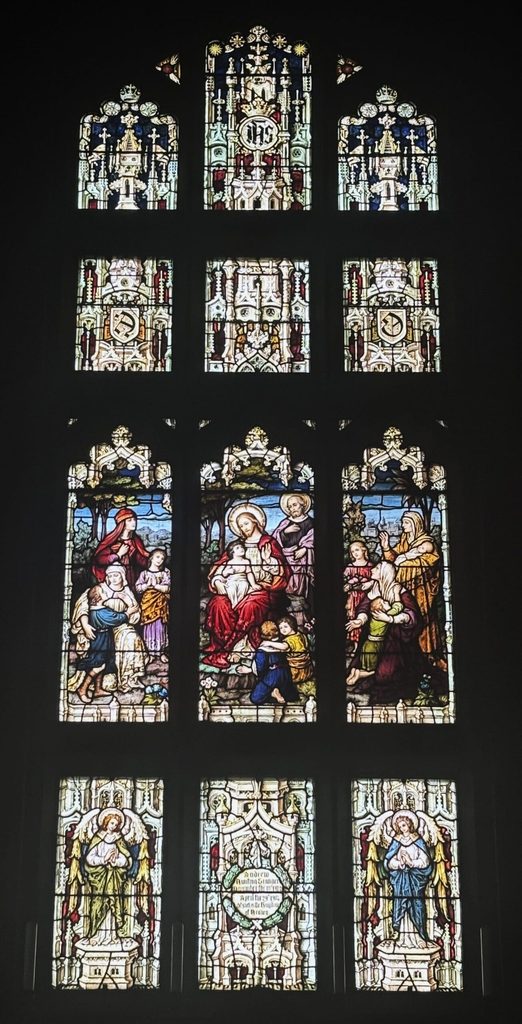
The great west window depicts Jesus calling the little children to him. It is the only window in the church that dates from the original construction of the building. It was executed in 1907 by the Franz Mayer studio of Munich, and was given by the Grainger family as a memorial to their infant son.
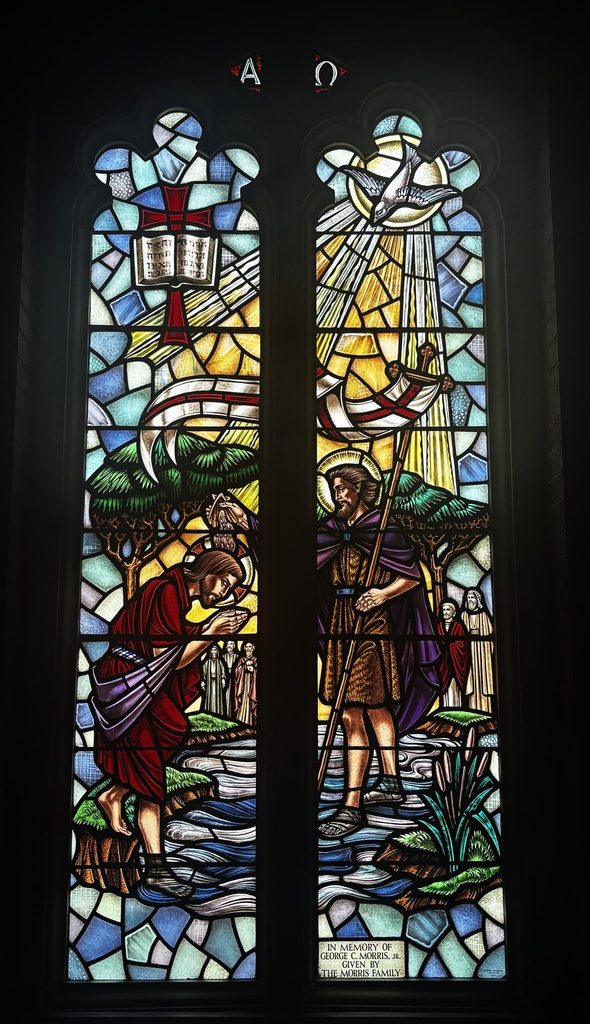
To the right of the great west window is the depiction of the baptism of Jesus by John the Baptist, as told in the three synoptic Gospels (Matthew, Mark and Luke). The dove symbolizes the Spirit of God descending upon Jesus and stating “This is my beloved Son.” The book and cross symbolize the word of God. At the top of the window are found the symbols A and W, Alpha and Omega, the beginning and the end.
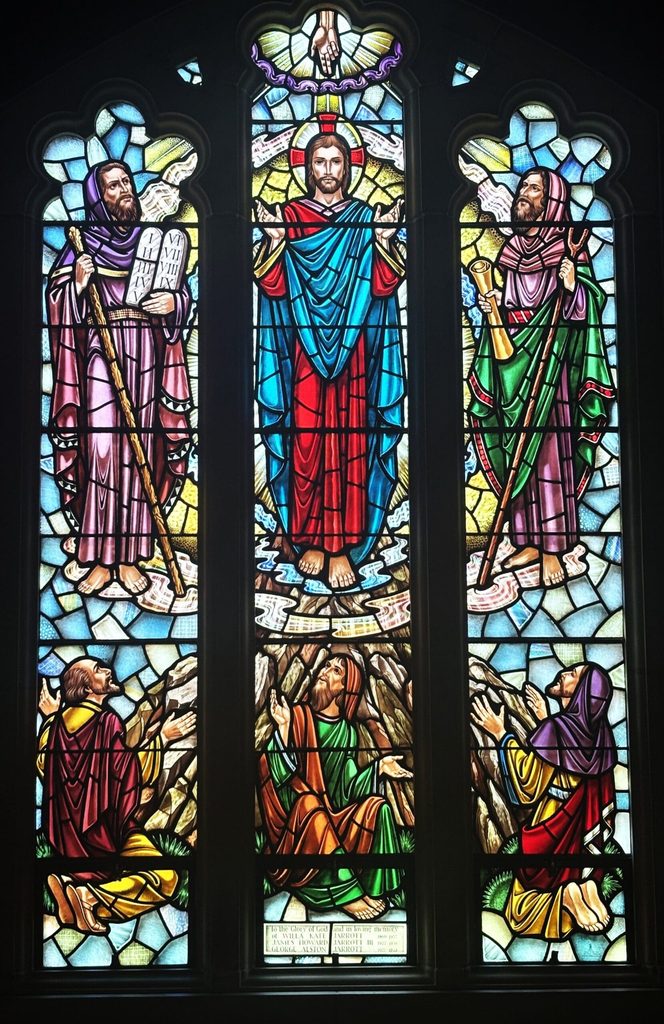
On the north wall of the nave are windows symbolizing the transfiguration and the feeding of the multitude. In the transfiguration window Jesus is shown with Moses and Elijah, who symbolize the law and the prophets. His raiment became whiter than snow, and his face was transfigured by glory. Again, this incident occurs in the three synoptic Gospels. Below Jesus, Moses and Elijah are the Apostles Peter, James and John. At the top of the window is a depiction of the Hand of God, symbolizing the Voice of God that said, “This is my Son, my Chosen, listen to Him.”
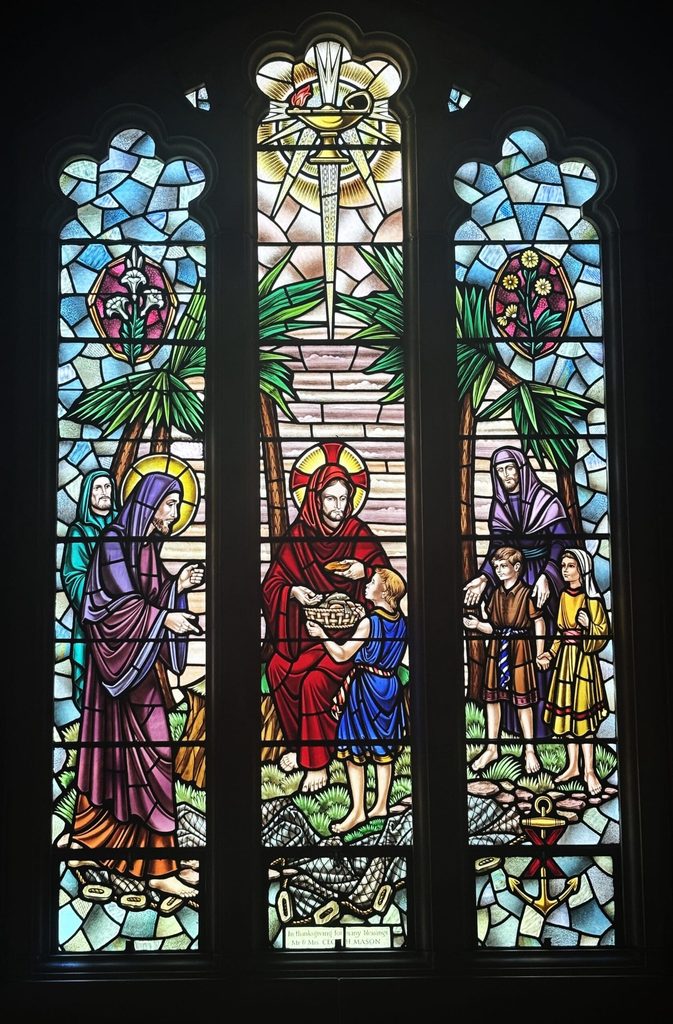
The other window on the north wall of the nave shows the feeding of the multitude, as told in the synoptic Gospels. The symbols in this window include the lamp which reminds us that Christ is the light of the world, lilies for purity, daisies for innocence, the anchor cross of faith and hope, and the net which symbolizes Jesus making the Apostles fishers of men.
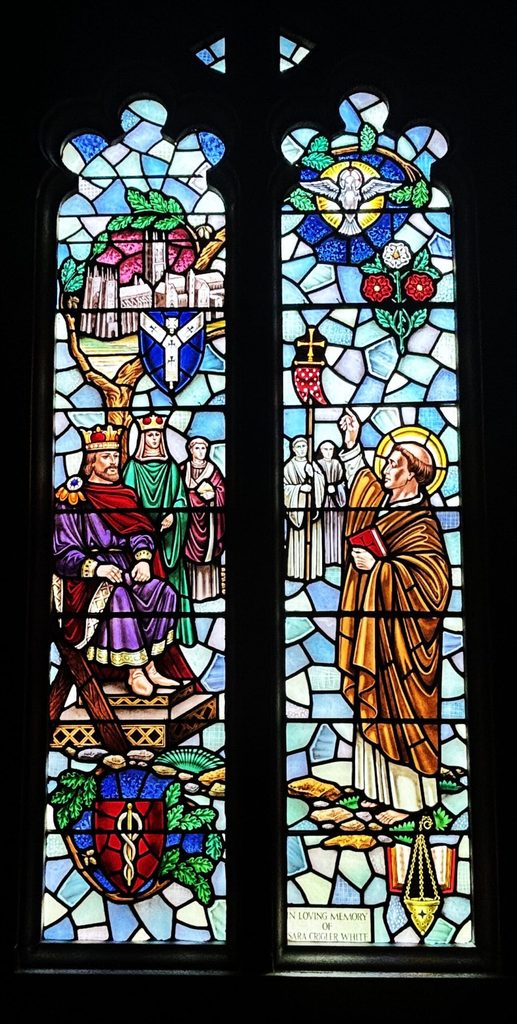
In the north transept are two windows that symbolize the life of the Church in the world. The first, on the west wall of the north transept, is specific to the life of the English Church and depicts the conversion of Ethelbert, King of Kent, and his wife Bertha, by St. Augustine of Canterbury. St. Augustine arrived in England in 597, converted and baptized King Ethelbert and his court, and went on to become the first Archbishop of Canterbury. Symbols in window include the cathedral and seal of the See of Canterbury, the dove of the Holy Spirit, a shield with a caduceus, and an open bible symbolic of prayer and the Word of God.
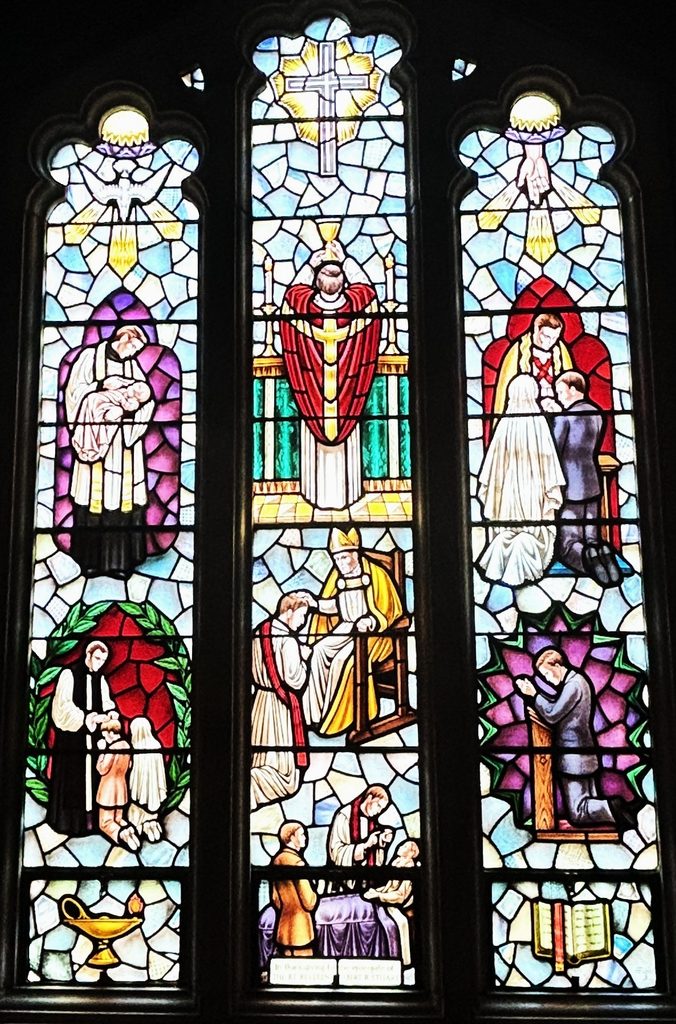
On the north wall of the transept is the window depicting the seven sacraments of the Church: The Eucharist is central, as it is in the life of the Church, surrounded by Baptism, Confirmation, Matrimony, Holy Orders, Penance and Unction (also known as the Last Rites). A laurel wreath surrounds Confirmation, symbolic of victory over self and sin, and a stylized crown of thorns surrounds Penance, to remind us of Christ’s agony and sacrifice, which was and is caused by our sins. Above the sacraments are symbolic depictions of the Trinity — the Hand of God, the Cross of Christ, and the Dove of the Holy Spirit.
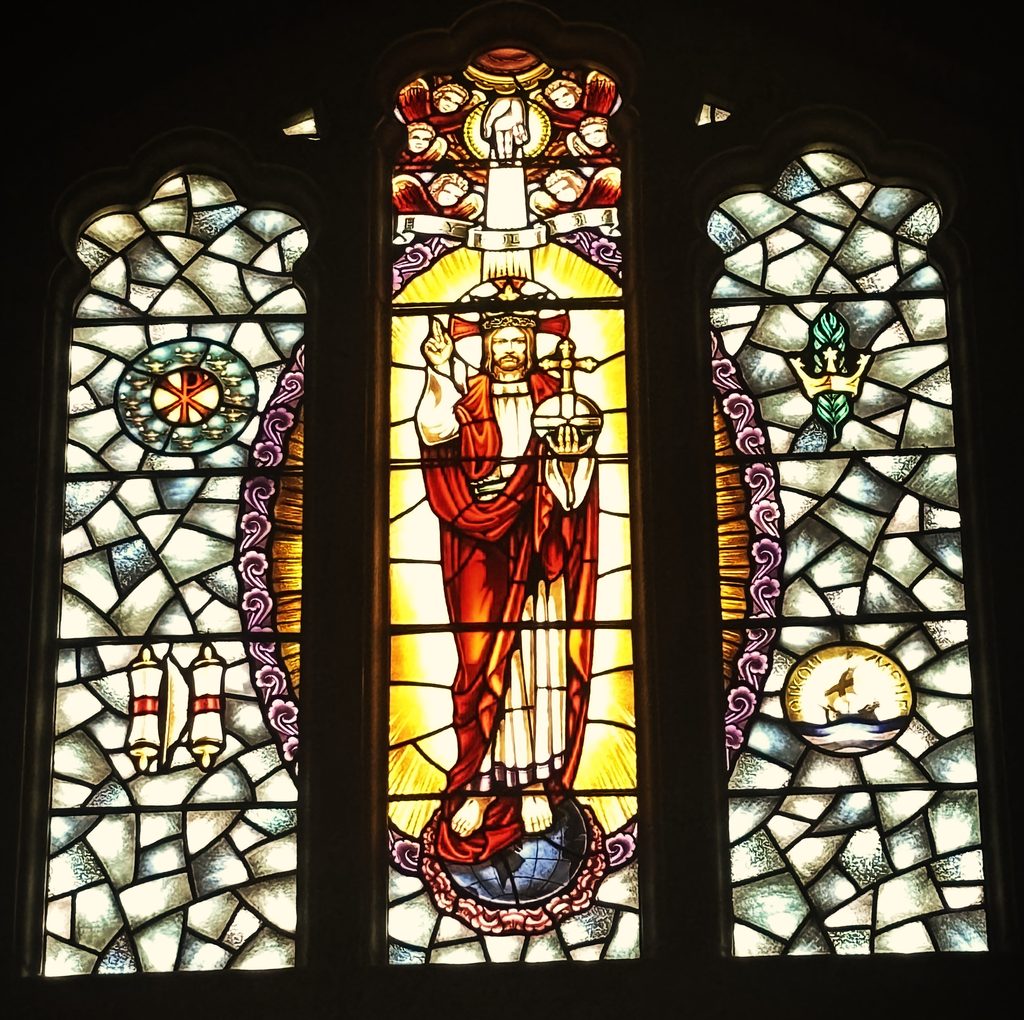
Over this window is a smaller window depicting the Kingship of Jesus over Creation. Jesus stands on the globe of Earth, holding an orb. The scroll of the Law, the sacred monogram Chi Rho, a ship symbolizing the Church surrounds him, and a branch of palm surrounded by a golden crown, symbolizing the resurrection.
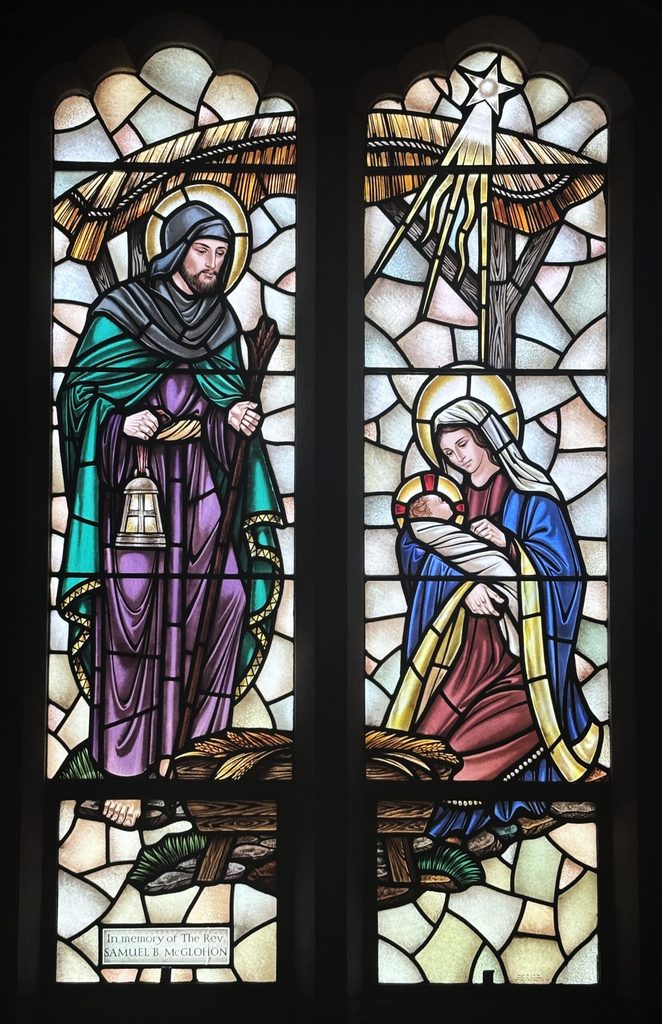
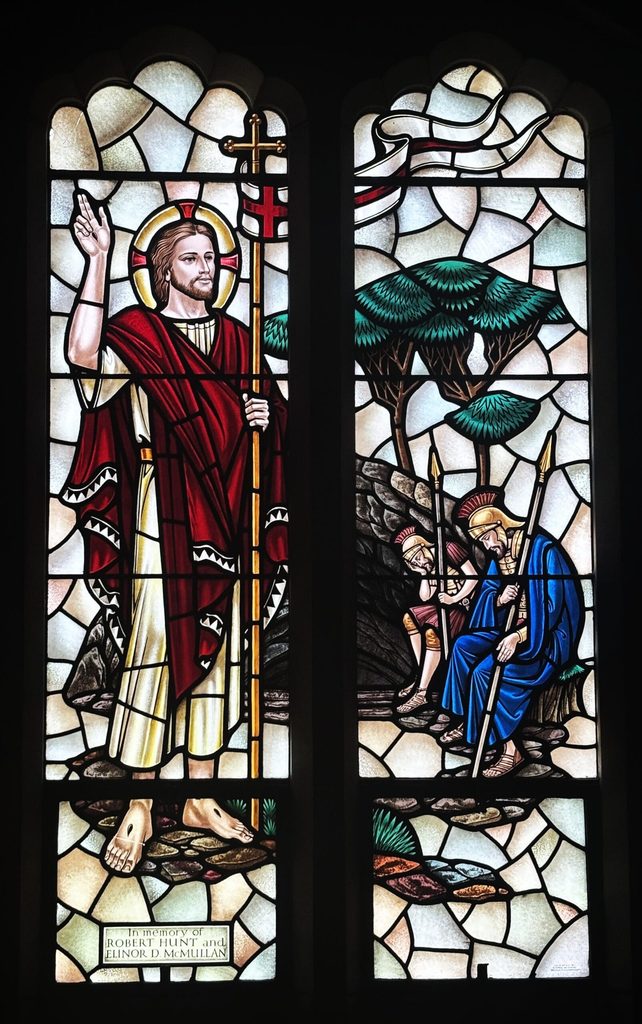
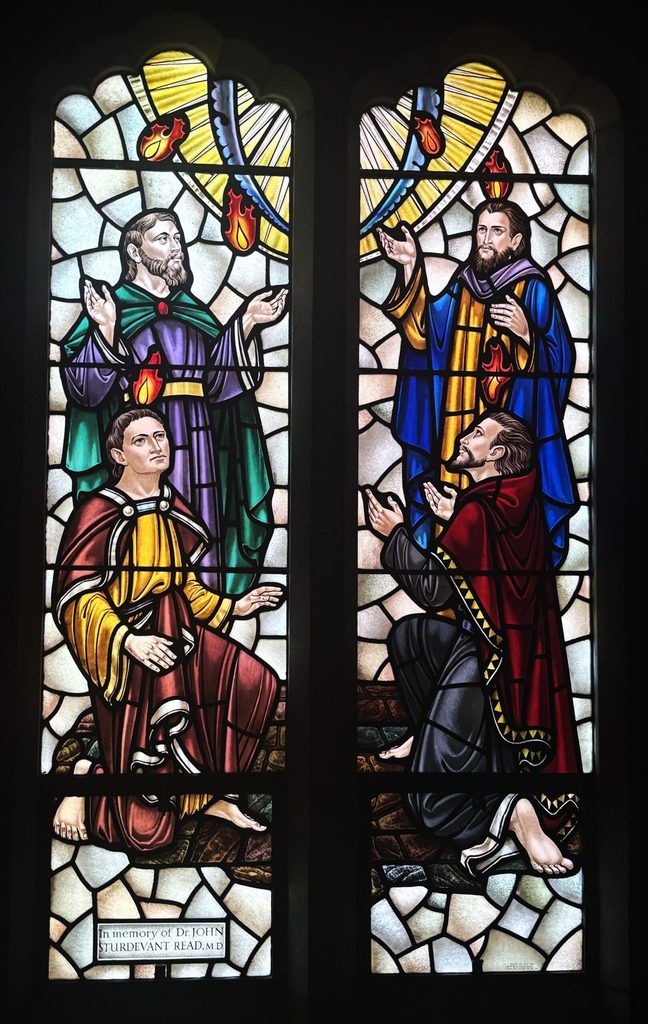
There are three charming windows in the Chapel of Our Lady of Walsingham, showing the story of Jesus in the Nativity on the left, the Resurrection in the center, and the Day of Pentecost, when the Holy Spirit, in tongues of fire, descended upon the Apostles to fulfill Christ’s promise of a Comforter on the right.